

Answer: AI news for marketers is only useful when it changes what your team does this week. A good roundup sorts every launch into three buckets: changes to production right now, changes to research or copy systems this month, and noise you can safely ignore. Between August and 12 November 2026 the list was long: Grok Bot teammates, Claude Code Projects, Meta Muse for small businesses, OpenAI’s Sponsored Agents and visual ads in ChatGPT, TikTok’s agentic ad tools, Google taking AI Mode ads global, Adobe’s Creative Agent at MAX and a new IAB attribution framework. Below is the weekly format we use, a dated November 2026 snapshot, and how Kreativemedia turns news into prompt and disclosure updates without inventing metrics.
Roundup rules
- Link primary sources: TechCrunch, The Verge or the vendor’s own newsroom.
- Separate context from proof: a launch story is not your case study.
- Name the workflow impact: research, copy, render, media buying or rights.
- Date every claim: prices and plan gates change.
November 2026 snapshot: AI news for marketers worth a team brief
Here is what we would put in front of a creative pod today, 13 November 2026, oldest story first. Every link below was opened and checked on that date.
Agent platforms (August and September)
The Verge (12 August 2026) described Grok Bot as an AI teammate you assign work to, running on a cloud computer and coming back when the job is done or needs approval. Three days later TechCrunch reported that SpaceX officially closed its Cursor acquisition, which matters if you track who owns the infrastructure behind Grok Bot. On 17 September The Verge covered Claude Code relaunching Projects to manage several AI agents at once. If you are choosing between the two for marketing work, our Grok Bot vs Claude comparison goes deeper.
On 29 September TechCrunch reported Meta expanding its Muse agent to small businesses, with integrations into commerce tools and Meta ads. That is the story most likely to reach a DTC founder’s inbox with the words “it runs your ads for you.”
Ads inside AI chats (September to November)
OpenAI published Reimagining advertising with AI on 16 September 2026. It introduced a test of Sponsored Agents, where a user who clicks an ad in ChatGPT can start a clearly labelled conversation with a business-sponsored agent. The same post added AI copy and image suggestions inside Ads Manager, an opt-in setting that adapts headlines to the conversation, and ChatGPT Ads integrations with HubSpot and Shopify. Sponsored Agents are being tested with select US advertisers.
On 5 October TechCrunch reported that OpenAI is adding visual ads next to images people generate in ChatGPT, starting in the US with a test group of advertisers. The Verge added that these ads won’t show to Plus, Pro or Enterprise subscribers. For creative teams, that is a new placement where your product imagery sits right beside AI-generated images, so brand safety and labelling questions arrive early.
Google moved too. TechCrunch (28 October 2026) reported that Google is taking ads in AI Mode to international markets and adding multi-turn ads in AI Mode in the US, announced on Alphabet’s third-quarter earnings call.
Social platforms build agents for advertisers (October)
At Advertising Week New York, TikTok’s newsroom (5 October 2026) announced Agentic Leads, a lead-generation agent for DMs and lead forms, plus Buy Direct checkout and a Shopping Assistant. It also said the TikTok for Business MCP is now available as a connector on several AI platforms, Claude and Perplexity among them. In practice, an agent you already use may soon be able to plan and manage TikTok campaigns. That’s exactly where your approval rules need to be written down.

Creative suites go agentic (Adobe MAX, 10 November)
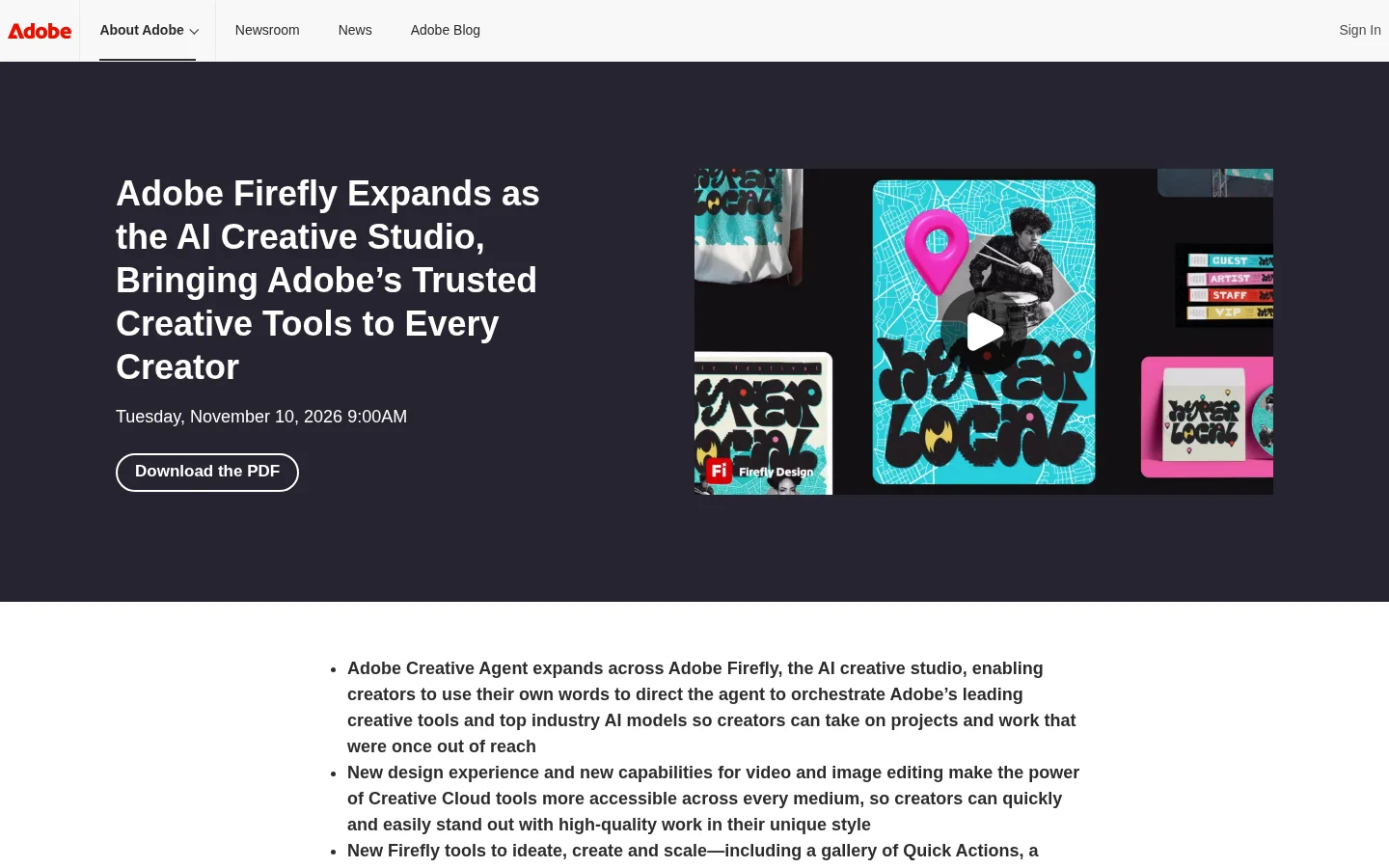
Adobe used MAX to expand Firefly as an AI creative studio. The Adobe Creative Agent now has Plan Mode, where you review and approve its plan before it runs, a model selector and saved brand preferences. Always-on agents (in preview) handle recurring jobs like organising incoming assets and preparing content for different channels. Quick Actions include a guided Build Product Ad workflow. On the enterprise side, Adobe is bringing CX Enterprise Coworker into GenStudio to create personalised asset variations. Adobe also previewed MCP integrations that let third-party agents call Photoshop, Illustrator, Premiere and After Effects.
Measurement catches up (IAB, 12 November)
Yesterday the IAB released its AI-Era Attribution Blueprint, which classifies each conversion as Human-Owned, AI-Assisted or AI-Executed and sets out what evidence a party needs before it can claim credit. IAB cites its own 2026 Outlook Study: 45% of ad buyers name comparing AI-driven and traditional journeys as their top measurement challenge. Digiday’s write-up points out the catch: much of the evidence sits inside AI platforms that don’t share it yet.

You don’t need to adopt every one of these. You do need a short Monday habit that decides which stories change prompts, rights notes or tool shortlists.
The weekly creative-team news template
- Headline in plain English. One sentence a media buyer understands.
- Primary link. Prefer the original report or the vendor’s own post.
- Workflow tag. Research, copy, render, buying, rights or ops.
- Action this week. Update a prompt, pause a tool, request a demo or ignore.
- Owner. Who checks the official page before anyone buys.
Paste the five fields into Slack or a Notion board. The public blog version should be shorter: three to five stories, each with its impact spelled out. Nobody needs every AI headline of the week.
How to score a story in under two minutes
| Signal | High priority | Low priority |
|---|---|---|
| Touches Meta, TikTok, YouTube or ChatGPT ad policy | Brief the pod the same day | – |
| Changes commercial rights or watermark rules | Update rights notes like Is Seedance safe for commercial use? | Ignore hobby model news |
| New agent can open Ad Library, Ads Manager or Gmail | Pilot in draft-only mode | Skip if you don’t use that connector |
| Fundraising or CEO interview only | – | Bookmark, no process change |
| Price cut on a tool you already use | Re-check unit economics with how much AI video ads cost | – |
Story cluster: agent platforms
Grok Bot, Claude Code Projects and Adobe’s Creative Agent all push multi-step work. For ad teams the useful question isn’t which brand won the week. It’s whether research packs, inbox triage or brief writing can run with clearer approval gates. Pair product walkthroughs with your own stop rules. A YouTube tour is education. Your sheet of failures is governance. For real examples of what these agents do on marketing tasks, see Grok Bot examples and our AI agent case studies for ad ops.
When Meta Muse, TikTok’s MCP connector or ChatGPT’s Ads Manager plugin ties into an ad account, treat write access as its own risk class. A read-only analytics connector and an agent that can edit campaigns are not the same thing. Say so in the roundup every time a vendor demo promises to run your ads for you.
Story cluster: ads inside AI chats
OpenAI’s Sponsored Agents test and its visual ads matter because creative strategy will start to include the conversation after the click, not only the landing page. That doesn’t mean rebuilding your funnel tomorrow. It means creative briefs should note which claims an agent is allowed to make if a chat format launches in your category. Google’s multi-turn ads in AI Mode point the same way.
Keep disclosure thinking in line with Meta AI disclosure. Platform labels and brand honesty still apply when the format is a chat agent instead of a UGC clip. If your team writes ad copy with Claude, the prompts in Claude examples for ad copy are a good place to add a “claims the agent may not make” line.
Story cluster: creative suite automation
Adobe MAX is a reminder that big suites will keep bundling generation, personalisation and workflow automation into one place. Smaller DTC teams shouldn’t panic-buy. Watch which of these features reach the mid-market tools you already use, then re-check unit cost the way we lay it out in AI UGC vs real creators cost. If video is your main output, our AI video ads guide covers which generator fits which ad.
Turning news into Kreativemedia publishing actions
Since 23 October 2026 our process has been one article per day, with prices checked on official pages, no invented tests and a final edit for robotic phrasing. When news breaks, we don’t invent a traffic lift. We ask three questions. Does a live post need a price or rights update? Does a draft in the queue need a new section? Or is this only material for a later article?
Agents can draft the digest. Humans decide what goes on the public site. That boundary is the real case study, not a mysterious ROAS chart.
Suggested Monday 30-minute agenda
- Five minutes: scan The Verge and TechCrunch AI sections, plus the newsrooms of vendors on your shortlist.
- Ten minutes: fill the five-field template for up to five stories.
- Five minutes: assign owners for any official-page checks.
- Five minutes: update one prompt library or disclosure note if needed.
- Five minutes: decide whether a public roundup post is worth it this week.
How to measure the week without inventing vanity KPIs
Start with three numbers any editor can collect without a BI tool. First, cycle time from brief request to an approved research pack. Second, edit rate: how many sentences a human rewrites before publishing or shooting. Third, rejection rate: how many packs get thrown away because the angle list was useless. Put those numbers in a shared sheet every Friday. After four weeks you’ll know whether the agent saves hours or just moves the same work into review meetings.
Don’t attach paid media ROAS to a research agent in the first month. Media results depend on offer, creative, audience, season and landing page. An honest ops win can sit next to a flat ROAS without turning into a failure story. When leadership wants a money metric, convert hours saved into the loaded hourly cost of the people who used to do the work. It’s still an estimate, but it’s closer to the truth than a fake conversion chart. The IAB’s new blueprint makes the same point at industry scale: a claim is not credit until you have the evidence.
Log failure modes in the same sheet. Captcha stops, rate limits, empty search results and hallucinated prices all belong there. Teams that hide failures over-automate the next sprint. Teams that list them end up with better stop rules and clearer human ownership.
Handoff from research agents into production
Research packs only help if producers can act on them the same week. Keep a fixed template: brand, offer, three angle families, proof links, banned claims and one suggested first test. Store the pack where the creative pod already works. Don’t start a second wiki that nobody opens.
Once a pack is approved, production follows our current guidance on AI UGC ads, Kling vs Seedance and Meta AI disclosure. Agents sit upstream of render tools. They don’t replace rights checks, credit math or disclosure decisions. For cost framing, keep how much AI video ads cost bookmarked next to the pack.
What to tell leadership when they forward every AI headline
Leadership inboxes fill up with vendor PDFs and LinkedIn panic. Your job isn’t to adopt everything. It’s to turn headlines into a yes, a not now or a never for your stack. Use one slide with five cells: story, workflow tag, cost to pilot, risk class, decision. If a story can’t fill those cells, it isn’t ready for a budget conversation.
Keep a short list of tools you re-evaluate every quarter. Everything else is just monitoring. That discipline protects creative capacity for work that already pays the bills: UGC tests, product film, landing page proof. Agents and suites can wait their turn behind a dated pilot plan.
When a headline mentions agents that can spend media budget, escalate slower, not faster. Read-only research agents and write-capable buying agents are very different tools. Put that sentence in every executive summary until it sticks.
Sample public roundup outline you can reuse
Open with one sentence on what changed for creative teams this week. Then add three story cards, each with a plain headline, a primary source link, a workflow tag and one action. Close with a “what we’re not changing” line so readers see restraint. That last line builds more trust than another breathless list of launches.
On Kreativemedia, a public roundup follows the same rules as our product reviews: no invented tests, no unverified prices, no dead links. If you mention a plan price, open the official page that day. If you mention a rights change, quote the vendor document. Agents can draft the skeleton, but editors still check every fact.
Internal digests can run longer than public posts. Public posts should stay easy to scan on a phone. If a story needs a deep dive, schedule a dedicated article instead of stuffing the roundup until nobody finishes it.
FAQs
How often should a creative team run an AI news roundup?
Weekly is enough for most teams. Go daily only if you’re mid-migration or reacting to a policy change.
Which sources should we trust first?
Primary reporting from outlets like TechCrunch and The Verge, plus the vendor’s own newsroom or changelog. Treat social media screenshots as leads, not proof.
What were the biggest AI news stories for marketers in late 2026?
OpenAI testing Sponsored Agents and visual ads in ChatGPT, TikTok’s agentic ad tools and MCP connector, Google taking AI Mode ads global, Adobe’s Creative Agent and always-on agents at MAX, and the IAB’s AI-Era Attribution Blueprint on 12 November 2026.
Should every launch become a blog post?
No. Most launches become internal notes. Publish when readers can take a concrete action.
How do agents help with the roundup?
They can collect links and draft summaries. Humans check the links, strip the hype and own the action column.
What do we do with Meta Muse or TikTok agent news?
Treat write access to an ad account as high risk. Map the features against your disclosure and creative process, including Meta AI disclosure.
How does this connect to UGC production?
News rarely replaces render tools overnight. Keep production guidance in AI UGC ads and Kling vs Seedance current when rights or pricing shift.
Can we cite fundraising news as product proof?
No. Fundraising is context. Product proof is a dated page, a demo you ran yourself or a policy document.
When should we update prices on Kreativemedia?
The same day an official pricing page changes for a tool we’ve already reviewed.

Jitendra Vaswani is an SEO expert, AI and marketing professional, and the founder behind Kreativemedia. He started BloggersIdeas in 2013, runs AffiliateBooster and SchemaNinja, and through DigiExe has worked with 1,400+ clients across 28 countries. He is the international bestselling author of Inside A Hustler’s Brain (20,000+ copies) and has spoken at Affiliate Summit, Affiliate World, DMSS and TES. Find him at jitendra.co.