

Answer: Kling AI pricing starts at $6.99 for the first month of the Standard plan (660 credits) and goes up to $127.99 for the first month of Ultra (26,000 credits). Renewals cost more: $8.80 for Standard and $159.99 for Ultra. Native 4K costs 30 credits per second. Prices checked on Kling’s official pages on 28 October 2026.
Quick verdict
- Best for: Standard or Pro while you test prompts; Premier or Ultra once you produce ads every week.
- Skip if: You plan to run free-plan output in ads. Kling says free Basic content is not for commercial use.
- Safe for paid ads: On paid plans, yes. Kling’s payment policy says members’ commercial use of output is not restricted, apart from building competing products.
- Credits roll over: No. Monthly plan credits expire; separately bought top-up packs last 2 years.
How much does Kling AI cost per month?
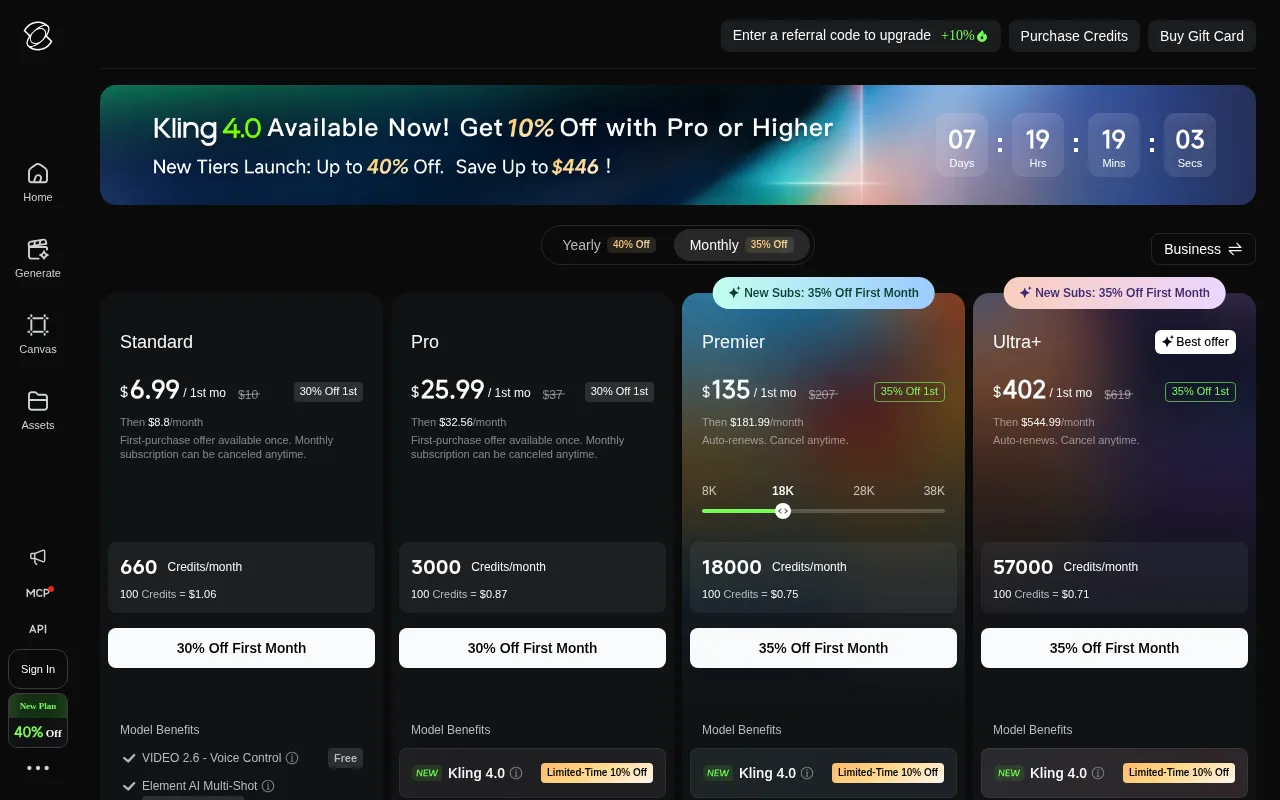
Kling lists these monthly plans in its credit cost guide and on its membership page:
| Plan | First month | Renews at | Credits/month | Kling’s own reference | Commercial use |
|---|---|---|---|---|---|
| Basic | $0 | $0 | none | n/a | No |
| Standard | $6.99 | $8.80 ($10 list) | 660 | 660 images or 33 720p videos | Yes |
| Pro | $25.99 | $32.56 ($37 list) | 3,000 | 3,000 images or 150 720p videos | Yes |
| Premier | $64.99 | $80.96 ($92 list) | 8,000 | 8,000 images or 400 720p videos | Yes |
| Ultra | $127.99 | $159.99 ($180 list) | 26,000 | 26,000 images or 1,300 720p videos | Yes |
The first-month price is a one-time discount for new subscribers, so budget on the renewal price. Yearly billing is cheaper still: Kling lists Standard at $79.20 a year, Pro at $293.04 a year, Premier at $728.64 a year and Ultra at $1,429.99 a year on its membership pages (figures checked with the monthly table above).
For how those numbers sit next to Creatify, HeyGen, Arcads and agency quotes, see How much do AI video ads cost? and Kling vs Seedance.
How many credits does a Kling video use?
Kling lists native 4K for the Kling VIDEO 3.0 series at 30 credits per second, and clip lengths from 3 to 15 seconds. Kling’s own plan reference (660 credits for 33 720p videos) works out to about 20 credits per 720p video. Credit use also changes with the model, the mode, native audio and clip length, so check the live generation panel before a big batch.
If you buy Kling through Arcads instead, Arcads charges Kling 3.0 at 176 to 560 credits per generation in its own credit system (Arcads help centre). That is a different credit ledger from Kling’s own membership credits, so do not mix the two when you forecast spend. Arcads plan context is in our Arcads review.
What’s the real cost per usable Kling clip?
Use this formula: cost per usable clip = (monthly plan price ÷ plan credits) × credits per clip ÷ the share of clips you can actually use.
Here’s how that plays out on the Pro renewal price. $32.56 for 3,000 credits is about 1.1 cents per credit. A 720p clip at roughly 20 credits costs about 22 cents. If only one in three generations is good enough for an ad, your usable clip costs about 65 cents. A 5-second 4K clip at 150 credits costs about $1.63 per attempt, and about $4.88 per usable clip at the same one-in-three rate.
Worked example on Standard renewal: $8.80 ÷ 660 ≈ 1.33 cents per credit. Ten prompt retries at ~20 credits each burn about 200 credits (~$2.67) before you keep a winner. That is why Kling’s own guidance to run a short test generation before scaling matters more than the sticker price.
Developers can compare this with Kling’s API, which bills per second. Kling lists Kling-V3 at $0.084 per second in standard mode and $0.112 per second in pro mode without audio, and $0.42 per second for 4K. That’s $0.42, $0.56 and $2.10 for a 5-second clip.
Top-up credits vs monthly plan credits
Kling’s credits / point policy separates membership credits from purchased credits:
- Membership subscription credits are issued with the plan and are valid for about one month from distribution. Unused monthly credits do not roll over.
- Purchased top-up credits stay valid for 2 years from distribution.
- Kling’s published standard top-up reference is $1 USD = 66 credits (promotions may change the rate on the purchase screen).
- Failed generations are refunded; shorter-validity credits are consumed first.
For agencies with spiky calendars, a Pro or Premier seat plus occasional top-ups is usually cleaner than jumping to Ultra for one launch week — then sitting on expiring monthly credits.
Can you use Kling’s free plan commercially?
No. Kling’s credit guide says free Basic content “is not for commercial use”, while every paid plan says “generated content is for commercial use”. Kling’s payment policy adds that members’ commercial use of output is not restricted, except for building products that compete with Kling. So never ship free-plan Kling output in a paid ad.
Which Kling plan should a brand or agency buy?
Start on Standard or Pro while you work out your prompts, and move up once you know how many clips you keep. Standard’s 660 credits run out fast if you retry a lot. Pro gives you 3,000 credits and pro mode, which suits a small team testing ads each week. Premier and Ultra make sense for agencies producing at volume or delivering 4K. Kling itself advises running “a short test generation before scaling”, and that’s the cheapest way to find out.
If the brief is talking-head UGC rather than product motion, compare Kling against avatar tools in Creatify vs Arcads and AI UGC vs real creators before you lock a Kling seat.
How to cut Kling credit spend (steps)
- Test at 720p and only re-render the winners at higher resolution.
- Use 5 to 6 second clips instead of 15 seconds when the beat allows. Kling suggests this too.
- Use clean reference images to reduce retries.
- Skip 4K unless the placement needs it.
- Buy top-up packs for one-off spikes, since they last 2 years while plan credits expire monthly.
- Log credits per kept ad so you can re-forecast the next month instead of guessing.
Reading Kling’s membership page without getting stuck on the first-month price
Kling’s membership UI highlights the discounted first-month number. For forecasting, ignore that number after month one and use renewal pricing:
- Standard renews at $8.80 (list $10) for 660 credits.
- Pro renews at $32.56 (list $37) for 3,000 credits.
- Premier renews at $80.96 (list $92) for 8,000 credits.
- Ultra renews at $159.99 (list $180) for 26,000 credits.
Yearly cards cut the effective monthly rate further (Standard $79.20/year, Pro $293.04/year, Premier $728.64/year, Ultra $1,429.99/year on the pages we checked). Lock yearly only after you know your monthly keep-rate; otherwise you prepay for credits that still expire each month inside the annual term.
Member benefits that affect ad production — not just sticker price — include watermark removal, professional mode, fast-track generation, master shot / video extension, and (on higher tiers) priority or early access. Those features change how many credits you burn on retries, which is often a bigger cost lever than moving up one plan tier.
Agency forecasting worksheet (no invented benchmarks)
Use only your own keep-rate. Do not copy someone else’s “one in three” as a promise — the worked example earlier is an illustration, not a Kreativemedia test result.
- Count credits on 20 generations for your product category at the resolution you actually ship.
- Divide kept ads by generations to get your keep-rate.
- Credits per kept ad = credits per generation ÷ keep-rate.
- Dollar cost per kept ad = (plan renewal ÷ monthly credits) × credits per kept ad.
- Add human edit time and platform media spend separately — Kling’s fee is only the generation line.
If you buy Kling inside Arcads, rebuild the worksheet on Arcads’ 176–560 credit range per Kling 3.0 generation and Arcads’ plan price, not Kling’s $8.80 Standard seat. Mixing the two credit systems is the fastest way to blow a retainer estimate.
For a wider DIY-vs-agency cost frame, use How much do AI video ads cost?. For Higgsfield’s credit model as an alternative multi-model seat, see the Higgsfield review.
Commercial-use wording on Kling vs Seedance routes
Kling’s paid plans state that generated content is for commercial use, and its payment policy says members’ commercial use is not restricted except for building competing products. Seedance through Dreamina US is more restrictive on commercial use of the Services and content, while Seedance through paid HeyGen or Creatify follows those platforms’ ownership clauses. That contrast is why pricing alone should not decide the stack — rights language should. Details: Is Seedance safe for commercial use? and Kling vs Seedance.
We do not publish invented win-rate scores or “lab” clip counts for Kling. Prices and credit rules above come from Kling’s membership, credit-guide and payment-policy pages; anything we cannot confirm on those pages is left out. Method: How we research.
FAQs
Is Kling AI free?
There’s a free Basic plan with no monthly credits listed and no commercial use. Kling says new users get free credits on sign-up.
How much is Kling 4K?
30 credits per second, per Kling. Through the API it’s $0.42 per second.
Do Kling credits roll over?
No. Kling says unused monthly credits don’t roll over. Credit top-up packs bought separately stay valid for 2 years.
Is Kling cheaper than Seedance?
It depends on where you buy each one. We compare them in Kling vs Seedance. Seedance commercial rights also vary by access route — see Is Seedance safe for commercial use?.
Should I buy yearly Kling?
Yearly Standard ($79.20) and Pro ($293.04) cut the effective monthly rate versus renewal pricing if you already know you will stay on the tool. Prefer monthly until your keep-rate and monthly clip volume are stable.
Get help from Kreativemedia
Want this done for you instead of testing it yourself? Kreativemedia can make AI video ads for your product. Get in touch through blog.kreativemedia.io or read how we research prices and terms.

Jitendra Vaswani is an SEO expert, AI and marketing professional, and the founder behind Kreativemedia. He started BloggersIdeas in 2013, runs AffiliateBooster and SchemaNinja, and through DigiExe has worked with 1,400+ clients across 28 countries. He is the international bestselling author of Inside A Hustler’s Brain (20,000+ copies) and has spoken at Affiliate Summit, Affiliate World, DMSS and TES. Find him at jitendra.co.