

Short answer: HeyGen vs Arcads comes down to the kind of ad you make. Arcads is the better fit for short UGC-style hooks: it’s built around AI actors for paid social, and an Arcads 1.0 talking-actor video costs 800 credits for up to 2 minutes. HeyGen is the better fit for longer spokesperson videos, custom avatars of yourself and localization, with a public price list that starts at $29 a month for Creator. Prices and terms below were checked on both official sites on 3 November 2026.
HeyGen vs Arcads at a glance
| HeyGen | Arcads | |
|---|---|---|
| Built for | Avatar and spokesperson videos, translation, training and marketing | AI actor ads for paid social (UGC hooks, demos, unboxing) |
| Entry price | Free plan; Creator $29/month ($24/month billed yearly) | Starter plan with 8,000 credits; dollar prices shown in the app only |
| Export resolution | 1080p on Creator, up to 4K on Pro and Business | All models up to 4K on every plan |
| Max video length | 1 min Free, 30 min Creator and Pro, 60 min Business | Arcads 1.0 talking video up to 2 min |
| Languages | 175+ languages and dialects on paid plans | 74 languages with accents for talking actors; 176 options in Translate Video |
| Product in hand | Product Placement app (best with small, handheld products) | Yes, the actor holds your product or shows your app |
| Commercial use | Paid plans: you own the output. Free plan: no commercial or advertising use | Non-exclusive licence to use the video, including for paid ads |
| Free trial | Free plan, no card needed | 72 hours with 1,000 credits, card required |
Sources: HeyGen pricing, HeyGen terms, Arcads pricing help article, Arcads AI avatars for ads and Arcads terms, all checked 3 November 2026.
What is the main difference between HeyGen and Arcads?
HeyGen is a general AI video platform. You record about 15 seconds of yourself (or pick one of 700+ stock avatars on paid plans) and turn scripts into talking videos, translations and presentations. It’s used for sales outreach, training and marketing, and Harvard Business School now uses HeyGen avatars of its instructors in a $699 startup bootcamp, as TechCrunch reported in August 2026.
Arcads is narrower. It’s an ad tool, and its actor library is filtered for paid social: gender, age, situation, accessories and emotion. Actors can hold your product, and the same script can be run across many actors or languages to test hooks. Arcads also runs third-party video models (Veo 3.1, Seedance 2.5 and Kling 3.0 Pro) from the same credit balance.
So the question is less “which avatar looks better” and more “what am I shipping”. A media buyer testing 20 hooks a week on Meta is Arcads’ target customer. A founder who wants to appear in every video without filming, or a team translating one video into ten markets, is HeyGen’s.

How much do HeyGen and Arcads cost?
HeyGen publishes every price; Arcads publishes only credit amounts. Here’s what each official page says today.
HeyGen pricing
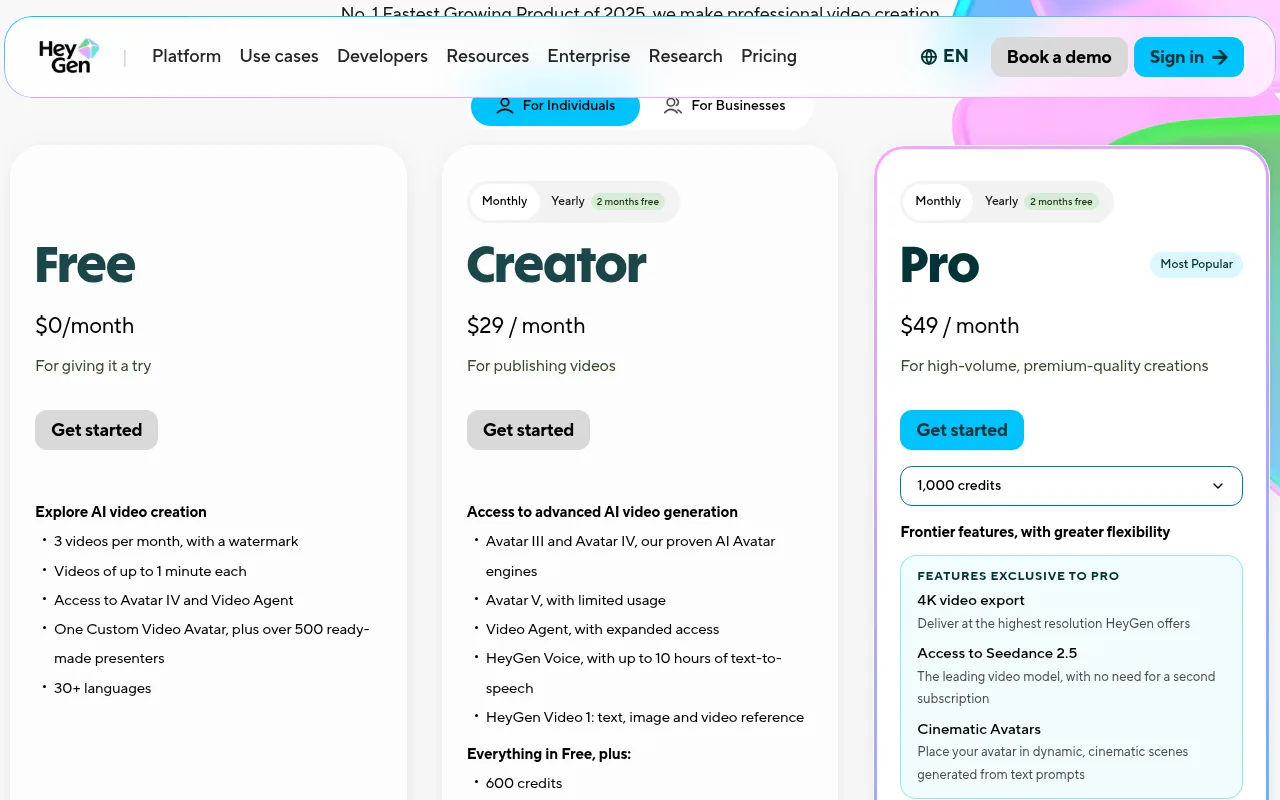
| Plan | Price | Credits | Key limits |
|---|---|---|---|
| Free | $0 | n/a | 3 watermarked videos a month, up to 1 minute each, 30+ languages |
| Creator | $29/month, or $24/month billed yearly | 600 a month | 1080p, no HeyGen branding, custom avatar with your voice, 175+ languages, videos up to 30 minutes |
| Pro | From $49/month | From 1,000 a month | 4K export, Seedance 2.5, Veo 3.1 and Nano Banana, Cinematic Avatars, faster processing |
| Business | $149/month plus $20 per extra seat | 1,500 a month | Videos up to 60 minutes, shared workspace, SAML/SSO, brand kit, 5 custom avatars with Avatar V |
| Enterprise | Contact sales | Custom | No maximum video length |
Pro is tiered. Every Pro tier has the same features and only the credit allowance changes, from 1,000 credits at $49 up to 100,000 credits at $4,300 a month. HeyGen says the credits a video uses depend on the AI model, the length and the complexity, and it doesn’t publish a fixed per-minute rate on the pricing page. Monthly subscribers’ unused credits roll over for one more month; on annual plans they build up until the renewal date (HeyGen pricing, checked 3 November 2026).
Arcads pricing

| Plan | Credits per month | At the limit | Unused credits |
|---|---|---|---|
| Starter | 8,000 | Generation stops | Reset each cycle |
| Creator | 16,000 | Generation stops | Reset each cycle |
| Pro | 48,000 | Overage billed on next invoice | Roll over |
| Scale | 96,000 | Overage billed on next invoice | Roll over |
| Business | 192,000 | Overage billed on next invoice | Roll over |
| Enterprise | Custom | Custom | Custom |
Arcads says current dollar prices are on the pricing page inside the app, and yearly billing is 20% off. We couldn’t confirm the dollar amounts on a public Arcads page, so we’ve left them out rather than quote a number that may be wrong for your account. Check the in-app pricing page during the free trial.
What a video costs in credits, from the same Arcads help article:
- Arcads 1.0 talking-actor video: 800 credits, up to 2 minutes
- Audio-Driven or OmniHuman 1.5: 800 credits per started minute
- Veo 3.1 clip (8 seconds): 800 credits
- Seedance 2.5, 5 seconds: 210 credits at 720p or 520 at 1080p
- Kling 3.0 Pro: 240 credits for 5 seconds, 400 for 10 seconds
- Translate Video: 240 credits per started 30 seconds, per language
- Custom actor: 1,600 credits, once
That means 8,000 Starter credits cover about 10 Arcads 1.0 talking-actor videos a month. Each actor counts as its own video, so one script run across 10 actors uses the whole Starter allowance. Arcads also notes that it tests new pricing from time to time and the Generate button shows the real cost on your account before you spend anything.
Which is cheaper for short ad hooks?
For a solo marketer, HeyGen is cheaper to start: the Creator plan is $29 a month with a public price, and the Free plan lets you try the editor without a card. Arcads asks for a card even for the trial, and its Starter price is only visible in the app.
Per video, the comparison is harder because the two tools count credits differently. Arcads gives you a clear number for its own talking model (800 credits per video up to 2 minutes), so a 15-second hook and a 90-second script cost the same. HeyGen’s credit use varies with the model and length, so you’ll only know your real cost per clip after rendering a few on your plan. We haven’t run a controlled cost test of our own yet, so we’re not putting a cost-per-usable-clip figure on either tool. Our AI video ad cost guide walks through how to work that number out from your plan and your keep rate.
If you’re weighing either tool against hiring creators, see AI UGC vs real creators: cost compared.
Which tool makes more convincing UGC-style ads?
Arcads is designed for this format and HeyGen is not, at least not by default. Arcads’ actors are filmed and tagged for ad situations, you can add gesture presets and emotion tags inside the script, and every plan includes Mark, Arcads’ AI agent for building ads. The Arcads team wrote in its seed funding announcement (December 2025, $16M led by Eurazeo) that the platform serves over 6,000 clients with UGC-style actors, product demos, fashion try-on and unboxing formats.
HeyGen’s strength is identity. Avatar V builds a digital twin from a 15-second recording and is meant to keep your face and voice consistent over long scripts, which suits founder-led ads where the same person appears in every video. HeyGen also has a UGC video ads use case and a stock avatar library, so you can make UGC-style hooks there. It just takes more setup to make them look like a phone-shot creator clip.
Both companies show realistic talking heads in their own demos. Judge them on your product, with your script, during the free trial or Free plan before you commit.
Can HeyGen and Arcads avatars hold your product?
Yes, both can. Arcads lets you put your product in the actor’s hands or your app on their phone as part of the normal ad flow.
HeyGen does it through a separate app called Product Placement. According to HeyGen’s help center, you upload a product image, pick an avatar, choose one of four combined images, then add a script of up to 5,000 characters and render with Avatar IV at 720p or 1080p. HeyGen says it works best with small, handheld products; larger items such as furniture may be scaled down to fit in the avatar’s hand.
Which is better for localization?
HeyGen covers more languages. Its paid plans list 175+ languages and dialects, translation script proofreading on Pro, and video translation up to 30 minutes on Creator and Pro. HeyGen said in June 2026 that its users span 196 countries and that it passed $200 million in annual recurring revenue (Business Wire via Yahoo Finance).
Arcads is closer than it used to be. Its talking actors speak 74 languages with accents, and Translate Video offers 176 language and accent options, with audio-only or full lip-sync output and several languages per run. For ad localization at volume, both work. For long-form translation of training or webinar content, HeyGen is the stronger choice.
Commercial rights: HeyGen vs Arcads
Both tools allow paid ads on paid plans, with different legal wording.
HeyGen: on Creator, Pro and Business, HeyGen’s terms (last updated 16 October 2026) say: “As between HeyGen and you, you own all rights in your User Input or User Output, and does not restrict your ability to use User Output for your own purposes (including for commercial purposes).” The Free plan is different. Free plan output gets only a limited licence for personal, non-commercial and internal evaluation use, and may not be used for advertising. Don’t run Free plan videos as ads.
Arcads: the Arcads terms grant a non-exclusive, personal and non-transferable licence on each video, worldwide, covering reproduction, distribution and broadcast, paid or free. Arcads says it can’t grant an exclusive licence because another client could produce a similar video with the same actor. The licence bans using the video and actor for misleading or deceptive advertising, and for feeding the video into other AI tools that modify the image or voice. Arcads’ prohibited content list applies on every plan.
On either tool, don’t script an AI avatar as a real customer describing an experience it never had. That’s where FTC rules on fake testimonials bite, and Meta may label the ad as AI. Our guide to Meta AI disclosure for UGC ads covers both.
How to make a UGC ad in HeyGen
- Pick a stock avatar that fits your audience, or create your own avatar from a short recording.
- Write a short script with a hook, the problem, your product and a call to action.
- If the avatar should hold the product, open Apps, choose Product Placement, upload a product photo and generate the combined image.
- Choose a voice, set the video to 9:16 for TikTok, Reels and Stories, and add captions.
- Render, then make variations by changing only the hook so you can test them against each other.
How to make a UGC ad in Arcads
This follows Arcads’ own guide, How do I make an AI UGC ad in Arcads?
- Write a creator-style script with a hook, the problem, the product and a call to action. Emotion tags can go inside the script.
- Choose an actor from the library, or create a custom actor on Pro and above.
- Pick the talking model: Arcads 1.0 for scripts up to 2 minutes, Audio-Driven to use your own voiceover, or OmniHuman 1.5 for a more expressive read.
- Put the product in the actor’s hands, then generate the talking video.
- Add captions and run the script across more actors or languages to build test variations.
Which should you choose?
- Choose Arcads if you run paid social and need many short UGC-style hooks, actor variety and product-in-hand shots, and you’re fine with in-app pricing and a card for the trial. Read our full Arcads review first.
- Choose HeyGen if you want your own face in the ads, longer videos, broad translation or public pricing you can budget from today.
- Look at both and a third option if your main concern is price per clip. Our Creatify vs Arcads comparison and Arcads alternatives list cover tools with public prices.
New to the format? Start with our AI UGC ads guide.
FAQs
Is HeyGen better than Arcads for ads?
It depends on the ad. Arcads is built for short UGC-style hooks with AI actors and is the closer fit for paid social testing. HeyGen is better for founder-led ads with your own avatar, longer videos and translation into many languages.
Is HeyGen cheaper than Arcads?
HeyGen is cheaper to start, with a Free plan and Creator at $29 a month (or $24 a month billed yearly). Arcads doesn’t publish dollar prices outside the app, so a direct price comparison isn’t possible from public pages. Per video, Arcads 1.0 costs 800 credits for up to 2 minutes, while HeyGen’s credit use varies by model and length.
Can I use HeyGen videos in paid ads?
Yes, on the Creator, Pro and Business plans, where HeyGen’s terms say you own the output and can use it commercially. Free plan videos are limited to personal, non-commercial and internal evaluation use, so they can’t run as ads.
Can HeyGen avatars hold products?
Yes. HeyGen’s Product Placement app combines a product photo with an avatar and then animates it with a script. HeyGen says it works best with small, handheld products.
Does HeyGen include Seedance?
Yes, on Pro. HeyGen’s pricing page lists Seedance 2.5 as a Pro feature, along with Veo 3.1 and Nano Banana. Arcads also offers Seedance 2.5 from its credit balance, at 210 credits for 5 seconds at 720p or 520 at 1080p.
Does Arcads have a free trial?
Yes. It lasts 72 hours with 1,000 credits and every feature unlocked. A card is required, and the Starter monthly plan starts automatically unless you cancel before the trial ends.
Get help from Kreativemedia
Want AI UGC ads made for you instead of learning both tools? Kreativemedia can produce AI UGC hooks for your product. Get in touch through blog.kreativemedia.io.

Jitendra Vaswani is an SEO expert, AI and marketing professional, and the founder behind Kreativemedia. He started BloggersIdeas in 2013, runs AffiliateBooster and SchemaNinja, and through DigiExe has worked with 1,400+ clients across 28 countries. He is the international bestselling author of Inside A Hustler’s Brain (20,000+ copies) and has spoken at Affiliate Summit, Affiliate World, DMSS and TES. Find him at jitendra.co.