


Answer: AI UGC ads are short, creator-style video ads made with AI avatars and AI voices instead of filmed creators. They cost far less per video than a human creator: on Creatify’s Standard plan ($15 for 55 credits a month), a 15-second avatar video works out to about $1.36, while median creator rates sit around $100 to $150 per video (prices checked 1 November 2026). They work best for testing lots of hooks fast. They should never be scripted as a real customer’s testimonial.
Quick verdict
- Best for: brands and agencies that want to test many hooks, angles and languages every week.
- Skip if: your ad depends on a genuine customer testimonial or a hands-on product demo.
- Cheapest public entry plan: Creatify Standard, $15 a month ($10 billed annually) for 55 credits.
- Safe for paid ads: yes, if you use a paid plan and don’t present the avatar as a real customer.
AI UGC tools at a glance
| Tool | Entry paid plan | Resolution | Unused credits | Rights |
|---|---|---|---|---|
| Arcads | Starter, 8,000 credits a month (dollar price shown in the app) | All models up to 4K on every plan | Reset on Starter and Creator; roll over on Pro and above | Non-exclusive licence for marketing use |
| Creatify | Standard, $15 a month ($10 billed annually), 55 credits | Depends on the model; higher resolution uses more credits | Valid for 2 months | You own your creatives |
| HeyGen | Creator, $29 a month ($24 billed annually), 600 credits | 1080p on Creator, 4K on Pro | Roll over for one month | Paid users own output and can use it commercially |
Prices checked on the Arcads help center, Creatify pricing page and HeyGen pricing page on 1 November 2026. Sources are linked in each section below.
What are AI UGC ads?
AI UGC ads copy the look of user-generated content: a person talking to camera on a phone, holding a product, reacting to it or explaining why they switched. The difference is that nobody was filmed. An AI avatar reads your script in an AI voice, and the tool renders the video in a vertical format ready for TikTok, Reels or Shorts.
Most AI UGC tools work the same way. You write or generate a script, pick an avatar (also called an AI actor), choose a voice and language, and generate. Better tools let you show the product in the avatar’s hands, add captions and spin one script into dozens of variations. Some, like Arcads and Creatify, also bundle third-party video models such as Veo 3.1, Seedance and Kling for B-roll and product shots.
Do AI UGC ads actually work?
There’s no neutral public benchmark that proves AI UGC beats creator content, and we won’t quote performance numbers we can’t show you. What AI UGC does well is volume. You can test ten hooks for the cost of one creator video, find the angle that stops the scroll, then put more budget behind it.
The fair test is inside your own ad account. Run AI UGC and creator ads against the same audience with the same budget, then compare hook rate, click-through rate and cost per acquisition. Many brands end up with a split: a real creator for the hero testimonial and the hands-on demo, and AI avatars for hook testing and translations.
Which AI UGC tools are best?
The three tools most ad teams compare are Arcads, Creatify and HeyGen. They solve slightly different problems.

Arcads is built around talking AI actors. A flat 800 credits buys an Arcads 1.0 talking-actor video of up to 2 minutes, and every plan gets all models up to 4K. It suits longer actor-led ads and teams that want an API, team seats and custom actors (Pro and above). Read our full Arcads review.

Creatify has the cheapest public entry price and is strong at short product ads made from a link. Standard includes 300 AI actors and 50+ premium models, and Pro adds an Ad Agent, a competitor ad tracker and Ad Clone, which remakes an ad from a URL. Creatify says you own your creatives even after your plan ends. Our Creatify vs Arcads comparison goes deeper.

HeyGen is a general AI avatar platform rather than an ad-only tool. Creator includes Avatar III and Avatar IV, a custom video avatar with your own voice and likeness, and over 175 languages and dialects, which makes it useful for founder-led ads and translations. If none of these fit, see our list of Arcads alternatives.
How much do AI UGC ads cost?
AI UGC tools charge in credits, so the sticker price only matters once you know what one video uses.
Arcads sells monthly credit pools: Starter 8,000 credits, Creator 16,000, Pro 48,000, Scale 96,000 and Business 192,000. Starter and Creator stop generating at the limit and reset each cycle. Pro, Scale and Business roll unused credits over and bill extra usage on the next invoice. Yearly billing is 20% off. An Arcads 1.0 talking-actor video costs 800 credits for up to 2 minutes, so Starter covers about 10 of them a month. Audio-Driven and OmniHuman 1.5 videos cost 800 credits per started minute, and failed generations are refunded automatically. Arcads doesn’t publish dollar prices in its help center; it says current prices are on the pricing page inside the app (Arcads Help Center, checked 1 November 2026).
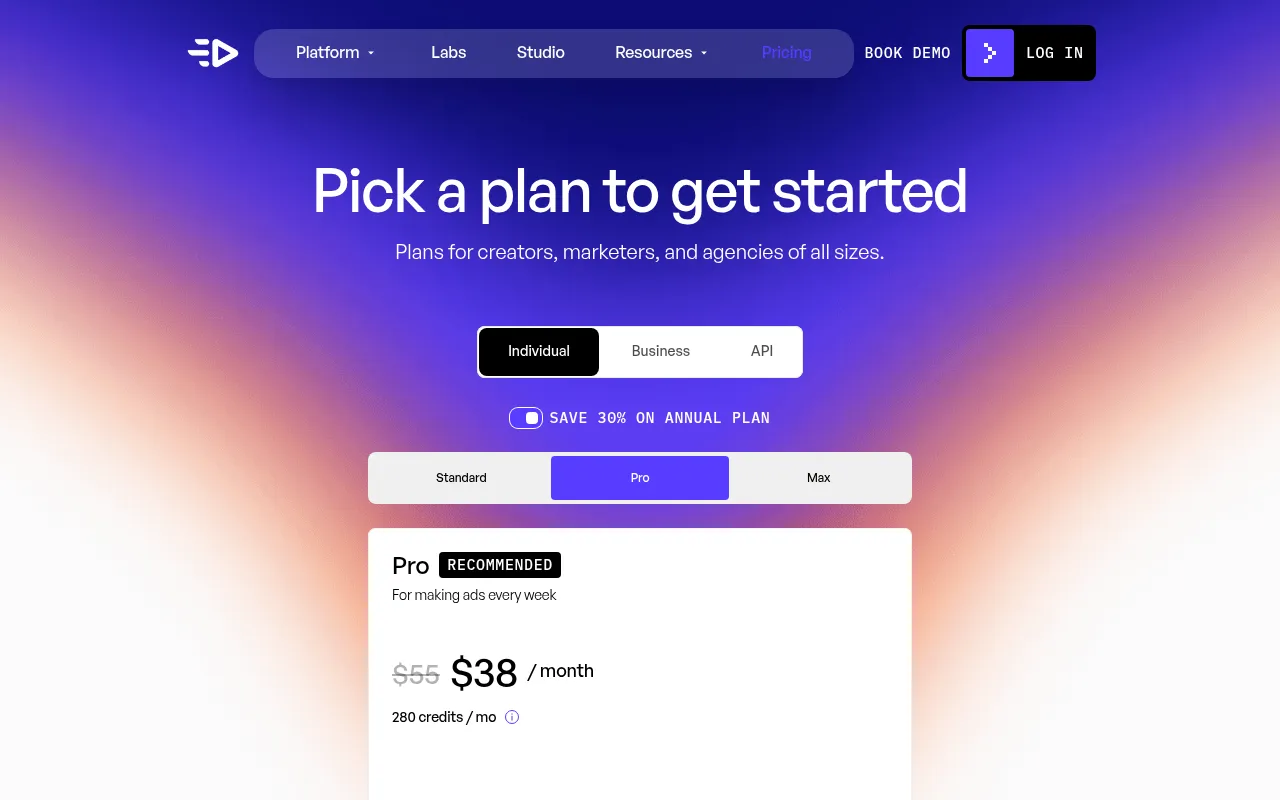
Creatify lists Standard at $15 a month ($10 billed annually) for 55 credits, Pro at $55 ($38 annually) for 280 credits, Max at $95 ($66 annually) for 730 credits, and Business from $195 ($136 annually) for a shared pool of 1,500 credits with no per-seat fees. Credits expire after 2 months. Creatify says 55 credits buy about 11 fifteen-second Aurora avatar videos at 720p, so one avatar video on Standard costs roughly $1.36 (Creatify pricing, checked 1 November 2026).
HeyGen lists a Free plan (3 watermarked videos a month), Creator at $29 a month ($24 billed annually) with 600 credits and 1080p export, Pro from $49 a month with 1,000 credits and 4K export, and Business at $149 a month plus $20 per seat with 1,500 credits. HeyGen doesn’t publish a fixed credit cost per avatar video on that page, so check the cost in the app before you budget (HeyGen pricing, checked 1 November 2026).
To compare tools fairly, work out your cost per usable clip:
Cost per usable clip = (monthly plan price ÷ plan credits) × credits per clip ÷ share of clips you’d actually run.
On Creatify Standard, if one in three avatar videos is good enough to run, a usable clip costs about $4.09. Even then it’s a small fraction of a $100 to $150 creator video. For the full side-by-side, read AI UGC vs real creators cost and our guide to how much AI video ads cost.
Are AI UGC ads legal?
Yes, with one big condition. The FTC’s 2024 final rule on fake reviews and testimonials bans reviews and testimonials that misrepresent that the person exists, that they used the product, or what their experience was. The rule took effect on 21 October 2024, and the FTC calls out AI-generated fake reviews by name.
The FTC’s questions and answers on the rule say there is no blanket ban on AI-generated avatars in marketing. An avatar’s script can still count as a testimonial, though, and it’s prohibited if that testimonial is fake or false. Using a celebrity’s likeness without permission is also out.
In practice, an AI avatar saying “I’ve used this for 3 weeks and my skin cleared up” claims an experience that never happened. Script AI UGC as a demonstration, an explainer or a narrated offer instead. Arcads’ own terms also ban using its actors for misleading or deceptive advertising. This isn’t legal advice, so check with a lawyer for health, finance and other regulated categories.
Do you need to disclose AI UGC on Meta?
Meta does it for you in many cases. Its help center says it labels ad images created or significantly edited with its own generative AI features, or created or edited with third-party AI tools, with AI info. The label appears on the “About this ad” screen in the three-dot menu, and sometimes next to the Sponsored label. Meta also says: “Not all ads will have AI info, like when there are minor changes or enhancements like image resizing or color correction.” (Meta Help Center, checked 1 November 2026.)
Ads about social issues, elections or politics carry a stricter rule: advertisers must disclose themselves when an image, video or audio was created or edited with AI (Meta Business Help).
How do you make AI UGC that doesn’t look fake?
Most AI UGC looks fake for the same handful of reasons. Before an ad goes live, check each clip for these:
- Lip sync. Watch the mouth on hard consonants and fast lines. If it drifts, shorten the sentence or regenerate.
- Hands and product. Fingers, labels and product size are where AI slips. If the product looks wrong in the avatar’s hands, cut to a real product shot instead.
- Lighting match. Real B-roll next to an AI avatar should share the same light direction and colour, or the cut gives it away.
- Script voice. Write the way people talk on camera: short lines, one idea each, a hook in the first second. Ad copy read aloud is the biggest tell.
- Captions. Native-style captions make the clip feel like organic content and help on muted feeds.
How to make an AI UGC ad, step by step
This follows Arcads’ own guide, How do I make an AI UGC ad in Arcads?
- Write the script the way a creator talks: hook, problem, product, call to action. Put the hook in the first line so you can swap it later.
- Pick an actor filtered by age, gender, type and setting, or build a custom actor if your plan allows it.
- Choose the talking model and voice. On Arcads that’s Arcads 1.0 for scripts up to 2 minutes, Audio-Driven for your own voiceover, or OmniHuman 1.5 for a more expressive read.
- Show the product by generating an image of the actor holding it, then animating it.
- Add captions and multiply the ad across hooks, actors or languages, then export.
FAQs
What is AI UGC?
AI UGC is creator-style ad content made with AI avatars and AI voices instead of filmed creators. It mimics the talking-to-camera look of TikTok and Reels ads.
Is AI UGC cheaper than creators?
Per video, yes. A 15-second avatar video on Creatify Standard costs about $1.36 in credits, while median creator rates sit around $100 to $150 per video. Per usable clip the gap narrows, because you’ll throw some AI outputs away.
Can AI avatars hold products?
Yes, on some tools. Arcads’ guide shows how to generate an image of the actor holding your product and then animate it. Check hands and labels closely, since that’s where AI most often slips.
Will Meta label my AI UGC ad?
Possibly. Meta labels ad images created or significantly edited with generative AI, including third-party tools, with “AI info”, though not every ad gets the label.
Are AI UGC ads allowed under FTC rules?
Yes, as long as they don’t fake a real customer’s existence or experience. The FTC says there’s no blanket ban on AI avatars in marketing, but fake or false testimonials are prohibited.
Related on Kreativemedia
Get help from Kreativemedia
Want this done for you instead of testing it yourself? Kreativemedia can make AI UGC hooks for your product. Get in touch through blog.kreativemedia.io.

Jitendra Vaswani is an SEO expert, AI and marketing professional, and the founder behind Kreativemedia. He started BloggersIdeas in 2013, runs AffiliateBooster and SchemaNinja, and through DigiExe has worked with 1,400+ clients across 28 countries. He is the international bestselling author of Inside A Hustler’s Brain (20,000+ copies) and has spoken at Affiliate Summit, Affiliate World, DMSS and TES. Find him at jitendra.co.